

Your child's target weight might be very wrong
Keeping your child underweight is a gift to the eating disorder. So it's understandable that parents and clinicians want to predict a healthy goal weight. Yet all prediction methods are flawed. It's more a case of, 'You'll know you're there when you're there'. Meanwhile, your child deserves specialist care. Too often a person is discharged from treatment just because they've reached a goal weight. Yet your child may need more weight, and they almost certainly need more work on normalising behaviours, and on navigating their life.
A target weight is like a weather forecast
Today's weather forecast is for sunshine, but do I take that as certain? No, it's just a prediction. Some sites seem to get it right more often than others. Likewise, all goal weights are estimates, and some calculation methods are overly simplistic.
If the forecast was for sun but it's actually pouring, I take shelter. I don't insist that the sun really is shining. Likewise we must keep assessing our child's needs, rather than get over-focused on a number.
You can skip this page if, very wisely, your clinicians tell you not to focus on a goal weight. What matters most is you keep doing the work.
* For my main page on weight restoration, and a guide to navigating the uncertainties around weight targets, see 'Weight-restoration: why and how much weight gain?' *
On this page
If your child has been given a healthy weight goal, chances are the clinician used one of two methods:
1️⃣ One is 'middle-size-fits-all'. The words used will sound like 'percent weight for height' or 'median BMI'. You wouldn't choose shoes that way. By definition, a median or middle number under-represents half of the population.
2️⃣ The other method is better because it predicts healthy weight from a plot of your own child's growth history. So there's more personalisation. But you still can't rely on that number because an individual's growth isn't as neat and tidy as growth charts imply.
⚠️ I'll show you how the 2 methods can give vastly different predictions.
✅ And I'll urge you to embrace uncertainty: you'll only know your child is truly weight recovered when all the physical and mental signs are good, not when you reach a number predicted by either method.
A weight target could be so wrong that your child will stay stuck
If you're in a hurry, jump to the infographic below. If you do read this page, you'll be able to tell which method has been used for your son or daughter, and you'll be able to have an informed discussion with clinicians.
If you're a clinician and you're using a calculator or app to work out target weight, I hope that what follows will prompt you to follow the lead of some of our top experts and bin the calculator. If you're using growth charts, I hope that this page and my other page on growth charts will help you appreciate how they only provide part of the picture.
I'll explain how the middle-size-fits-all method is likely to fail around half of patients. That's because you can't beat an eating disorder if you're attached to a weight target that's too low. People who are still suffering physically and/or mentally are failed when treatment stops just because they've reached a particular number.
These messages from parents should ring alarm bells:
- 'She's at 95 percent, so we're nearly there' (if I ask, 95 percent of what, they don't know, because they thought they'd be judged if they asked.)
- 'His BMI is 20, so he's being discharged next week' ('the eating disorder is as strong as ever, but the young man has been told that if he doesn't take responsibility for his recovery the service can't help him')
- 'She has a massive exercise compulsion and she's been told when she's reached 90 percent she can return to her swimming team.'
- 'The doctor says his labs and heart rate are concerning, but the therapist says that because he's at xx percent weight-for-height he's OK to go to school'
- 'My 12-year old lost 20 pounds, which according to the doctor means she's now healthy' (the weight loss puts this girl in danger, and it's irrelevant that her BMI is now 'normal')
But first, why a weight target?
Why indeed? Some experts make the case that a goal weight is useful, and some say not. My main post on weight restoration (here) discusses pros and cons of having a weight target.
Growth Chart + Adjustments, versus One-Size-Fits-All
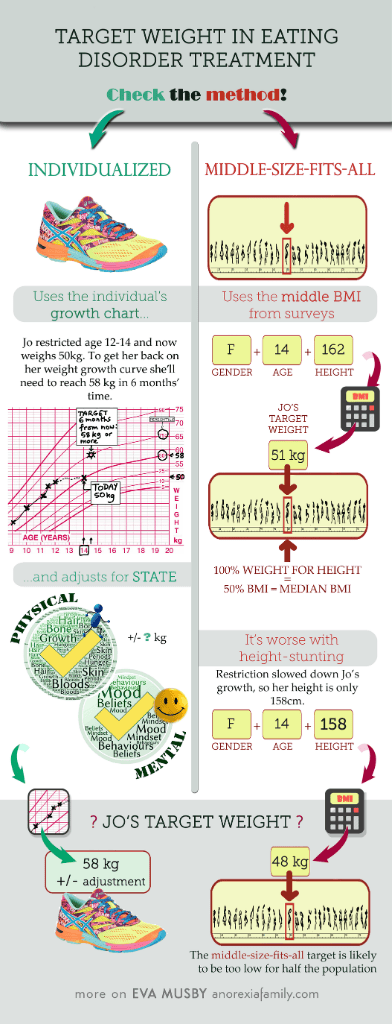
I want to highlight how very different a goal weight can be, depending on which of the two methods is used: growth chart versus '100% weight-for-height'.
I worked out target weight for a fictional child — not an extreme example — and found their target weight would differ by 10 kg (22 pounds).
It's summarised in this infographic (which you're welcome to copy and share, as long as you keep it just as it is – and please click on it to get a better quality image):
The top experts use an individualised approach
By an individualised approach (left hand column), I mean that the expert will regularly assess your child's changing physical and mental state. While they may plot your child's growth on a percentile chart, they won't pick a goal weight or range from it — it will just be part of a wider picture, that's regularly reviewed and adjusted.
On the right hand column, we have a goal weight set to be 100% weight for height. If you hear '100% of median BMI' or '50th centile BMI', that's the same thing. This is out of step with current recommendations.
Here are just a few quotes from experts. For many more, please head over to my page 'Experts say, "Recovery weight should be individualized".
'Treatment goal weight should take into account premorbid trajectories for height, weight and body mass index; age at pubertal onset; and current pubertal stage"
Position Paper of the Society for Adolescent Health and Medicine (USA) (2016)
"There is no one right size that fits all when it comes to healthy weight after anorexia nervosa. Thus anyone who uses an equation (such as a BMI or ideal body weight calculator) or simplifies this complicated situation is relying on tools that are inadequate."
Dr Jennifer Gaudiani, internist and expert on the medical complications of eating disorders, in 'Weight goals in anorexia nervosa treatment'
"The idea that […] everyone should be at medium BMI – that is just not the case and not appropriate"
Daniel Le Grange, co-author of the FBT treatment manual, in this webinar
"In young individuals, a “biologically appropriate weight” is associated with normal historical development."
AED Guidebook for Nutrition Treatment of Eating Disorders (2020)
"Goal weights typically take into account patient’s height, age, premorbid growth curve percentiles for height and weight, prior growth trajectory, growth potential, pubertal stage, anthropometric measurements and other physiological factors"
Faust et al (2013) 'Resumption of menses in anorexia nervosa during a course of family-based treatment'
A one-size-fits-all model is still tragically common
If your child's weight target is a particular BMI or 'weight-for-height', then read on to understand why it may be severely underestimated.
It's sometimes called the 'BMI method'. As I'll show, it's a one-size-fits-all model. Or more precisely, a middle-size-fits-all.
The BMI method uses big BMI surveys from the population (well, often it's a white american population). The assumption is that your child will be fine in the middle: the median.

Imagine I'm about to open a shoe shop and I'm busy ordering stock. I'm looking at statistical charts and I'm thinking, frankly, why so many sizes? Too much uncertainty! I'll sell one stylish model in one size for each age, and everyone will be happy!
Of course, there’s more flexibility around weight than shoe size. But when the BMI method predicts a number far inferior to the growth method, surely we have a problem.
If you want a sense of how very different weight targets are from place to place, see this study by Roots et al, described in plain English by Tetyana in 'Setting a target weight: an arbitrary exercise?'
The calculator is way off
I used to think that 'weight-for-height' (median BMI) calculators would at least give a rough estimate. But you need only take a peak at a BMI chart (girls, boys) to appreciate the wide range of BMIs in a normal population. A median BMI will only fit the most 'average' patients. For everyone else the calculator is so very wrong that it doesn't even cough up a decent ballpark figure.

How a growth chart is used (imperfectly) as part of the healthy weight prediction
Experts will be interested in your child's historical heights and weights. It will help them as part of the picture of what a healthy weight might be for them.
Please remember that, as I show you how a growth chart is used. (You may prefer to see a demo on my YouTube and then you can skip to the next section of this page.
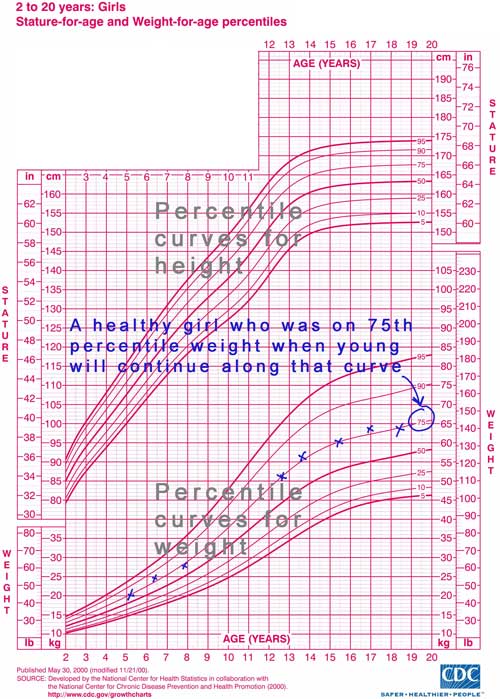
Below is an example of a growth chart for girls, with curves indicating percentiles.
* I explain percentiles here *
Here's the principle: if a girl was on the 75th percentile curve for weight when young and healthy, we predict that this is where she'll need to be throughout life to continue being healthy. I want to stress this is a very imperfect guide: in real life, healthy youngsters are deviating temporarily or permanently from percentile curves.
Dig out all the weight data you have from your child’s early years. Stature (height) data are useful too: they may show that growth was stunted by malnourishment. They may give clues on growth spurts that are due or that have already happened.
Your child could have started restricting quite a bit earlier than you think, or they may have lost weight during an illness or just because of metabolic factors that form part of the eating disorder risk. So go back as many years as you can. Indeed, people who have anorexia in their teens have often dropped off their growth curve as toddlers.
On the example below I’ve plotted the weight of Jo, a girl who tracked on the 75th percentile for weight until age 12. The next time she was weighed, on her 14th birthday, she weighed 50kg (110lbs). Can you see how, while she gained 2 kilos, she dropped from the 75th to the 50th percentile curve?

I'm not showing her height data, but perhaps her height has also dropped off its percentile curve, indicating some growth stunting. Her body will need fuel to catch up.
(Note: We could also plot her growth on a BMI chart, by the way. I mention it because some therapists do that. Again, the assumption is she should track on a particular percentile curve — the 60th percentile for example. So a therapist might say the target BMI is 60th percentile, and work out the target weight from that. But BMI is a bit volatile (rather wiggly on a chart), so you'll get a clearer picture sticking to a height chart and a weight chart.)
So we get to work on refeeding, which takes time. Let's look at where she might need to be in, say, six months' time. No point in giving her a target that will be obsolete by the time she gets there.
From the chart, we look at the 75th percentile curve and find a target weight of 58 kg (128lbs).

Health is not a number — not even a number from a growth chart
Any prediction from a growth chart comes with uncertainty because:
- When we plot a child's growth, we see that over the years, they've oscillated around a range of percentiles. It can be tricky to decide which percentile to 'pick'.
- The 'rule' that a child's healthy height or weight stays on one curve is alluring, but those curves are statistical compilations — mostly of white-Caucasian kids. Healthy children will have growth spurts where, for a while, they deviate from those curves. Also, we've all seen kids who used to be average height and suddenly became giants.
- And what if your child fell off their growth percentile really early on, and that was not serving their health needs. What if their anxious nature stopped them from eating to their needs, for example?
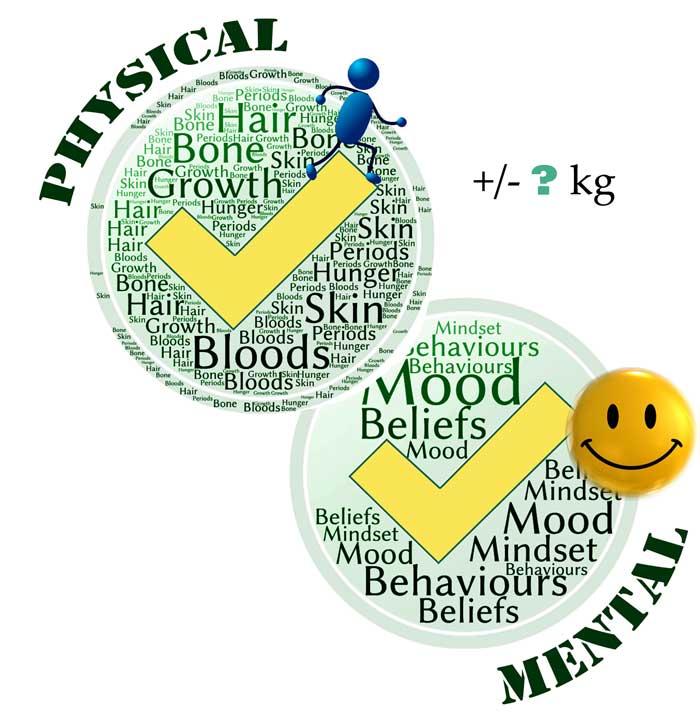
- Weight is only a proxy for health. It's absolutely fundamental and you won't get recovery if it's underestimated. But at some stage, you'll be focusing more on the physical and mental state of your child. That may mean a previous goal weight is adjusted — with care — up or down.
How is a 'middle-size-fits-all' weight target calculated?
Let's move on to the middle-size-fits-all method. In scientific papers it may be called 'the BMI (or median BMI) method', or it may refer to the use of 'normative population data'.

This approach doesn't look at your child's personal situation but at population surveys. It just plucks out the average and serves it to you as a recommendation.
Clinicians share with each other apps or Excel spreadsheets to make this simple. So simple that the prediction has an aura of certainty. I know of clinicians who have no idea what's behind the 'percent weight-for-height' number that they report so diligently in the patient notes. So I'll explain now.
Let's return to our 14-year old girl. Her growth chart hinted that she urgently needs to increase her weight from 50 to 58 kg. How does that compare to the BMI app's results?
You type in her sex, age and height. The answer pops up: her 'ideal' or 'target' weight is 51 kg.

More terminology for you: that's the weight that corresponds to the median BMI, or the 50th percentile BMI, or to 100 percent weight-for-height. ('Median' is a kind of average: it's the middle point in a range. I explain BMI and weight-for-height (WFH) here. ).
Giving this girl a 51 kg target is like having her walk into a shoe shop and insisting that a middle-sized shoe will fit her.
Let's be clear: any girl of that age and height will get that exact same target weight. Yet out there in the real world, girls of that age and height come in a wide range of weights:

The only personalisation that goes into a weight-for-height figure is:
- sex
- age
- and height.
Not family body-types, genetics, metabolism, nutrients, body composition, puberty, growth spurt needs, healing needs — nothing.
For a clinician relying on a calculator, this girl, who weighs 50kg, is so close to the app's target weight of 51kg that she really doesn't need to gain weight. Sadly it's common for therapists to say that 95 percent weight-for-height is plenty — they hate to stress out a patient by aiming for more. This girl is already at a 'generous' 98 percent (in case you're wondering, the app coughs up the 98, but you can also work it out by dividing 50 by 51).
The clinician hasn't asked for the girl's height or weight history, so all they see is a girl with an eating disorder who doesn't need weight gain 'because' her BMI is perfectly average. They don't see any need for weight gain, and most worryingly, they might not see any need to check her health. Yet this girl's health is very much at risk right now, given how much she's dropped off her weight curve. (Lots more on all this in my post 'Weight-restoration: why and how much weight gain?')
Truly, this happens a lot, especially with GPs. As I was writing this piece I got this naive email from a parent: 'My daughter (13 years) has lost at least 10 kilos in the last 3 months [that's 22 pounds], but she is still at the 25th centile, so no need to admit her or do bloods.' Luckily, the GP who gave this flawed advice did refer her to the eating disorder service. They recognised the weight suppression and gave energetic and competent care.
In summary: According to her growth chart the girl in our example needs to gain 8 kg (20 pounds, or more than 1 stone) as the aim is 58 kg in six month's time. She is currently very underweight and needs to be carefully monitored. A clinician relying on a calculator would say she's fine and doesn't need any weight gain as she is already at 98 percent weight-for-height.

It's even more wrong with height-stunting
With a restricting eating disorder like anorexia, it's common for our children's growth to be halted or slowed down. So, what if in the past year, this girl hadn't grown? Let's plug into the app her current 50 kg, but this time let's say her height is only 158cm.

Now her ‘ideal’ weight comes up not at 51 kg but 48kg. Remember that right now she weighs 50kg. Her eating disorder now has confirmation that she's fat. It tells her she must lose more weight.

The app doesn't know that her growth was stunted. It doesn't know that she's been restricting, that she's lost out on weight, and her body is in 'famine' mode. It's just looking up the middle BMI for girls that height.
This girl's body is crying out for nutrition and energy for growth, yet the 'middle-size-fits-all approach would set her healthy weight 10 kg (22 pounds, or 1.5 stone) lower than indicated by her personal growth chart.
Can you see how a calculator doesn't even give a useful ballpark figure? And I didn't even choose an extreme example. With another child, with different height and weight parameters and a different history, the difference could be even bigger.
Indeed, papers have been published where the two methods were compared for real patients. Real patients who historically started off heavier than my 'Jo'. The result: the difference between the two methods were even more alarming.
Results from studies comparing the two methods [Click]
While I did the maths for a fictional child named Jo, it's been done for real on 197 adolescents. Researchers retrospectively worked out a target weight based on their historical growth charts, and compared it to median BMI. Unsurprisingly, the growth chart method yielded a higher target for those who had historically tracked above median BMI.
What's striking is how big the discrepancy was:
"The absolute value of the difference […] ranged from 0.02 to 11.3 kg for [patients with anorexia] and from 0.3 to 19.3 kg for [those diagnosed with Atypical anorexia nervosa]"
Franklin et al (2024) 'Estimating Treatment Goal Weights in Adolescents With Anorexia Nervosa and Atypical Anorexia Nervosa: Comparison of the Median BMI and Historical BMI Percentile'
Note: In the above, we also have results from an eating disorder questionnaire that evaluates for the cognitive aspects of the illness. Unfortunately, the final questionnaire was applied before the end of treatment, so we can't infer any link between weight target and making a full recovery.
A similar study of 609 children and adolescent patients, also aligns with my maths: median BMI calculations probably give an underestimate:
"Results from this study indicate that an individualized approach led to significantly higher [expected body weight] compared with using [median BMI]. As underestimation of [expected body weight] may lead to higher risk of relapse, eating disorder professionals should consider using an individualized approach for setting expected body weight."
Steinberg et al (2023) 'Evaluating differences in setting expected body weight for children and adolescents in eating disorder treatment' (from a study of 609 children and adolescent patients)
Half of our children are kept underweight by the 'middle-size' approach

Because the median BMI, or 100 percent weight-for-height, is in the middle, it's going to be wrong for roughly half of our kids. That's because by definition, half the kids that sex and age have a lower BMI, and half have a higher BMI. That's what a 'median'is.

I'm not worried about the kids whose true healthy weight is below the calculator's target. The 'extra' weight will be used for growth. It won't do any harm. As I explain in my main weight-restoration page it's wise to have a bit of a buffer.
For the kids whose historical BMI has tracked close to the 50th percentile, both methods for estimating target weight will give roughly the same (imperfect) result. Be ready to adjust and review.
The problem lies with the 50% of kids who used to track at a higher BMI. With the middle-size-fits-all method, the weight target is a gift to their eating disorder.
➡️ As a parent, do give your clinicians any data you have. If you hardly ever weighed your child, it's still relevant to describe their build in comparison to their same-age, same-sex peers.
⚠️ When a therapist puts their faith in a calculator, the tail is wagging the dog. This teen doesn't yet have her periods at 100 percent weight-for-height? They'll return later. This girl is still skipping school lunch? It's time she took responsibility. This boy is still compulsively exercising? Well, you know, some people never recover.
'My kid is back'
Here's one story from a huge pool of similar stories that are everywhere on parent forums. These stories start with a child who stayed ill for months or years while supposedly 'weight-recovered' using a 'middle-size-fits-all' figure. At long last the child recovers when a new therapist, or the parents insist on a higher weight. There are plenty of similar stories with recovered adults too.
This is the story of a 14-year old boy who was 'stuck' with anorexia at an unsuitable weight:
My son was told that he was fully grown, and that as his BMI was 19, he was now weight-recovered and could maintain his current weight. But he was still terribly ill. He couldn't even drink a glass of orange without major anxiety. Eventually we sacked the therapist and resumed high calorie feeding. It was twice as hard as he had been told a BMI of 19 was PERFECT for him.
With weight gain, he grew another 5 inches. We got him to a BMI of 24 and kept him there. It's made all the difference. My kid is back. For the last two years he's been doing just great, fully functional, and in good recovery.
Where did this BMI of 19 come from? Looking at boys' BMI charts, I see that for a 14-year old it's the median percentile. This boy went from a disastrous 'middle-size-fits-all' to a weight that truly suited him.

What do the top experts say?
As you'll have gathered from the experts I have already quoted on this page, top professionals assess each individual for their needs.
Here are a few papers that explain the problem with a one-size-fits-all approach ('the BMI approach') and that strongly recommend that targets are individualised.
"Such methods [using median BMI], however, are unlikely to gauge the extent of weight recovery needed for individuals whose baseline weight was higher or lower than average, which may not only lead to partial recovery for these individuals but also may be partly responsible for the delays in care received by adolescents with higher weight histories"
Lebow et al (2017) 'Is there clinical consensus in defining weight restoration for adolescents with anorexia nervosa?'
"Treatment goal weight for a particular patient cannot simply be read off the charts on the basis of normative population data. Put another way, treatment goal weight is not necessarily the same as the weight associated with median BMI."
Golden et al (2015) "Update on the Medical Management of Eating Disorders in Adolescents"
"Professionals also use growth curves to establish target weights for recovery. Research shows that these curves, when available, are more accurate than using population averages to determine an individual's treatment goal weight."
Lauren Muhlheim in 'When your teen has an eating disorder'
One study Lauren Muhlheim cites is this:
"In most cases, [a growth curve] allows a clinician to easily estimate a patient’s healthy body weight and provides a number that is specific to the individual patient based upon their previous growth parameters, rather than on the population average for age (i.e. the 50th percentile).
Harrison et al 2013 'Growth curves in short supply'
Why does anyone use a middle-size-fits-all target weight?
I believe calculators and BMI charts are still widely in use because clinicians assume they yield, at the very least, a ballpark figure.
Hopefully I've done a good job of highlighting how this figure could be wildly wrong.
Also, clinicians may not appreciate what's behind the numbers produced by a calculator. They may see weight-for-height or median BMI defined as expected body weight in research papers, and assume this is transferrable to a clinical setting.
But there's a big difference between the care of an individual, and statistics for a test group of patients.
An analogy: if you were comparing various remedies for sleep deprivation, you could set 7 hours of sleep as your benchmark for success (even though some people actually need more, and some less).
For anorexia studies, most researchers have used median BMI as their benchmark. For instance in Lock and Le Grange's landmark study of FBT, for treatment to count as successful, teens had to do well on a behaviours and beliefs questionnaire and they had to reach 95 percent weight-for-height. Let's be clear: that 95 percent is a choice made for the sake of consistency in a moderately big trial. The authors are the first to say that in clinical work, healthy weight is individual.
"Clinically we use individualized weight calculations; this is not possible in research studies as the same outcome needs to be assessed in all participants."
James Lock, co-author of the FBT treatment manual, personal communication, March 2020
Is there any reputable therapist who endorses the 'middle-size-fits-all' approach?
In the world of children and adolescents, I have come across only one reputable researcher and clinician who has put pen to paper to advocate a 'one-size-fits-all' approach. This is Christopher Fairburn, who has researched and written on CBT for eating disorders. His manual (2008) used a fixed low BMI figure for all adults (for comparison, the weight goals in other treatments at the time tended to be even lower), and a fixed low BMI for older adolescents. Only for younger adolescents does he take age and sex into account by using a 100 percent weight-for-height target. He writes that in his experience, these targets work for most patients. However the success of CBT, when you take into account the dropout rate, is not very high. How much higher would recovery rates be if targets were not only higher, but individualised?
Should we bin the BMI calculators?
Before you dismiss all idea of BMI calculations, I'll highlight one valid use for them. It takes 30 seconds for a clinician to input a child's sex, age, height and weight, and guess — before they've even met them — that they are probably extremely thin and malnourished. If that raises a sense of urgency, great.
The reverse is not true, though: a child in significant medical danger may have a normal or above-average weight-for-height after losing a lot of weight.
In summary: 95% of what?
I hope this page will help you enquire what a therapist means when they say your child is x-percent weight-recovered. Most likely it's relative to a middle-size-fits-all number from a calculator.
Final thoughts
There is no number on the scales that can say a child is healthy. Let's keep up the teamwork between parents and clinicians to keep reviewing our children's needs. There is going to be uncertainty about your child's healthy weight, and you'll only know you're there when you're there. Meanwhile let's remember: 'First do no harm', and not throw around incorrect numbers that our children will fixate on.
More help from me:
* Weight-restoration: why and how much weight gain? *
My main page on healthy weight for eating disorder recovery. Why weight gain, how much, danger of a low target weight, buffers, overshoot, ‘stuck’ patients.
* Experts say, "Recovery weight must be individualized" *
A collection of quotes from professional institutions, researchers, clinicians and those who train clinicians
* What do BMI and Weight-For-Height mean? *
What BMI and Weight-for-height (WFH) and BMI z-scores mean, and how they cannot be used for advice. Read this if your child’s therapist uses BMI or WFH.
* My YouTube: 'What is a BMI or '% Weight-for-Height' target, and how wrong it could be' *
* Weight gain in growth spurts *
To help you let go of weight targets, I remind you that youngsters' growth is unpredictable and can go in spurts.
* Weight centile growth charts: why they can’t predict your child’s recovery weight *
How growth charts cannot predict a healthy weight for your child: I show you how they fail to show normal variations in healthy individuals and remind you that you won't know your child is weight-recovered until they get there.
* My YouTube: 'Growth charts and goal weights made simple *
If your child has failed to gain weight with age, or has lost weight, that's weight suppression. Make sure your clinicians aren't only looking at your child's current weight: here's evidence that the amount and speed of weight loss matter at least as much.
* Atypical anorexia diagnosis? Handle with care! *
What's 'atypical anorexia', the issue with weight being declare 'normal' or high, the risk from malnourishment and the need to regain lost weight.
* More on weight and feeding in Chapter 6 of my book and in my Bitesize audio collection *



From others:
* More on target weight on the excellent, parent-led FEAST site: 'Setting target weights in eating disorder treatment'
* Poodle Science: a YouTube from Association for Size Diversity and Health (ASDAH): A short fun video that makes the point that one size does not fit all *
* CDC (american) growth charts for boys and for girls. And here are UK ones. There's also access to WHO (World Health Organization) and CDC charts on mygrowthcharts.com *
Thank you to James Lock, Daniel Le Grange, Ivan Eisler, Esther Blessitt, Rebecka Peebles, and a whole lot of well-informed parents, for helping me write this post.
Leave a Reply