

With anorexia and similar eating disorders, you've probably had your child wailing , 'Am I fat?', 'Will you make me fat?' Grabbing at their skin as though they want to tear off a slice of their tummy. They have anorexia, their body image is distorted, they're fighting meals or 'fattening' food, they're terrified of getting gaining weight. So what do you say?
There are lots of possible replies you may give to those 'Am I fat?' questions. I believe that for pragmatic reasons, you may give different replies at different stages of your child's recovery journey.
A pragmatic approach to those 'fat' questions
In an ideal world, at any stage of your teen's disorder you could just say: 'There's nothing wrong with being fat'. And they'd go, 'Oh, wow, you're so right! Well I guess I'll have some more pasta carbonara, because the truth is I'm really hungry.'
I wish…
You need a well-functioning, non-anxious brain, and many hours of study, of listening to non-diet dieticians, of tuning in to fat-activists, to understand how the health messages we've absorbed around body fat are mostly wrong, and harmful. To appreciate quite how weight-biased, fatphobic our society is (think of 'fatphobic' like you think of 'homophobic' or 'transphobic'). To recognise thin-privilege.
One thing that's not going to change in a hurry is the discrimination and alienation that a person has to endure if they're fat. Your child has seen it. Like all phobias, there's a grain of truth that in their malnourished brain, has been amplified into a massive fear. They believe the only way to fit into their peer group, the only way to be a loveable, worthwhile human being, is to be (very) thin.
You'll know how while your child has an eating disorder, logic doesn't work. Nor does nuance.
That's why I don't think it's realistic to expect your malnourished, terrified, weight-phobic child to be chill with any body shape — not yet.
So what CAN you reply to those incessant 'fat' questions?
Because those 'Am I fat?' questions are so pervasive, and there's so much at stake when a meal isn't working, I've devoted many audios with suggestions in my Bitesize collection. And lots of pages in my book (Chapter 14 for what to say, Chapter 11 for prevention for your other children).


Here's a quick one:
'I'm sorry, it looks like this is really freaking you out. You know it's not useful to talk about it, right? So, let's do something to change the mood. Shall we plant some seeds?'
As always, use what works and leave the rest.

Podcast 'Mommy, am I fat?'

A while back I was on a podcast titled 'Mommy, am I fat?', exploring possible replies. My focus was on children and teens with anorexia, while the hosts were thinking more of children in general — which makes it interesting.
It's a great podcast series for parents wanting to promote a great attitude to body, food and exercise in any child. The Full Bloom Project was hosted at the time by two certified FBT therapists: Zoë Bisbing and Leslie Bloch. Zoë went on to produce some more very relevant resources on bodypositivehome.substack.com.
On the question of prevention
There's a bit that's missing in the podcast, where I question the prevention angle. I wouldn't like to create unrealistic expectations — that you can prevent anorexia by taking care of the way you talk about bodies and food. Plenty of us have raised our kids with a lot of care around that, and they still got anorexia. The Body Project, a well-validated body acceptance program in schools (which uses 'body dissonance' as mentioned in the podcast), has not shown a preventive effect on anorexia.
Still, there can only be benefits from us becoming even more aware of how we talk about body shape, given the toxic environment we live in. I point you to some great resources in How to overcome weight bias and fat phobia.
Nutrition and weight regain ease the fear of the 'wrong' body shape
Your responses to the 'Will you make me fat?' questions will evolve as your child gets nourished and makes up for lost weight. Paradoxically, the fear of weight tends to recede as weight increases.
So the most pragmatic response to 'Am I fat?' questions could be… whatever helps this meal work.
But don't expect weight recovery to fix body image
While you should see your child's body anxieties reduce as they get re-nourished, it's a myth that weight recovery solves all body image concerns. Indeed it's a myth that weight recovery brings recovery from an eating disorder. Sadly, that myth is so strong that some services discharge as soon as the person has reached a safe weight.
That's why in my resources I go into other aspects of the recovery work in detail.
Talk and listen, so your child can reflect
In my book and my Bitesize audio collection, I suggest a range of ways you can talk about weight and body shape when your child has an eating disorder.
I also recommend resources, such webinar: 'Addressing body dysmorphia and body image in eating disorder recovery' by Marisol Perez.
I also recommend this fantastic webinar : 'Helping loved ones cope with negative body image and body dysmorphia' by Anita Federici. It's part of the FEAST of Knowledge 2025 series so you'll need to buy access here. I think it's well worth it as several of the other talks in the series are top notch.
There's also a short but detailed guide to conversations with your child when they're having a surge of body-hating feelings: Michelle Cross on ‘How to decode bad body thoughts’. It's part of a skills education series from FEAST: you need to enroll, and it's free.
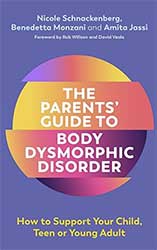
I've also found this book very informative: 'The parents' guide to body dysmorphic disorder' by Schnackenberg, Monzani and Jassi. It's not particularly about eating disorders, but the similarities in what to say, and what not to say, are uncanny. The insights from this book will no doubt help many parents of a child with anorexia.
If you're looking for exposure therapy for body image, see my review of Glenn Waller's books here.
More:
- Your child is likely to ask about the weight recovery target weight. More from me on Weight-restoration: why and how much weight gain? You'll see there how on the whole, we don't know what they'll need until they get there. So a quick piece of advice is not to get caught up in numbers.
- Lots more on speaking with compassion (and dealing with the inability of the stressed brain to take in logic) in my book and my Bitesize audios.
- My post How to overcome weight bias and fat phobia offers resources that we all need to educate ourselves.
LEAVE A COMMENT (parents, use a nickname)